
Breville and De’Longhi both offer extensive ranges of home espresso machines, but comparing the brands requires more than labeling one as premium and the other as affordable.
Breville is especially prominent in semi-automatic and assisted espresso machines, including compact models and machines with integrated grinders. De’Longhi covers compact manual machines, the grinder-equipped La Specialista range, and a broad selection of fully automatic bean-to-cup systems. Both brands therefore serve beginners, experienced home users, and convenience-focused buyers in different ways.
This Breville vs De’Longhi comparison examines their workflows, milk systems, compact options, pricing, and levels of automation so you can identify the brand—and, more importantly, the type of machine—that best fits your routine.
Quick Answer
Choose Breville if you want a refined semi-automatic or assisted espresso workflow with approachable controls and room to develop your technique. Choose De’Longhi if you prioritize a compact lower-cost machine, a broad selection of fully automatic systems, or greater variety across different brewing styles. Neither brand is universally better, so compare specific models from the same price and automation category.
Table of Contents
Key Differences at a Glance
| Feature | Breville | De’Longhi |
|---|---|---|
| Current range | Manual, semi-automatic, assisted, and automatic espresso machines | Manual machines, La Specialista models, and fully automatic bean-to-cup machines |
| Compact options | Bambino and Bambino Plus | Dedica line |
| Built-in grinder | Available on selected Barista and Oracle models | Available on La Specialista and fully automatic models |
| Milk systems | Manual or automatic, depending on the model | Manual steam wands or automatic milk systems, depending on the model |
| User experience | Strong emphasis on approachable control and guided home-barista workflows | Broad range from simple compact machines to one-touch automatic systems |
| Price positioning | Primarily mid-range to premium, with some more accessible compact models | Extends from budget-friendly compact machines to premium fully automatic models |
| Best fit | Buyers who want a refined semi-automatic or assisted espresso workflow | Buyers prioritizing compact affordability, model variety, or full automation |
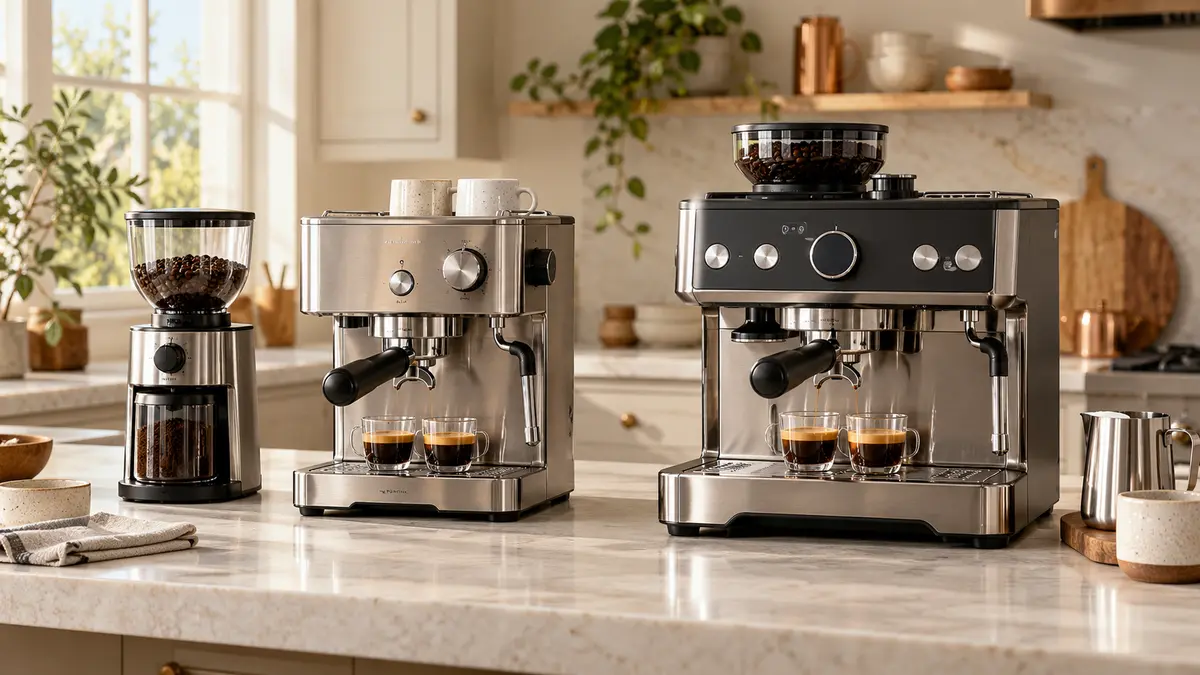
Build Quality and Design
Build quality varies across both brands’ product lines. Breville offers everything from compact machines to larger models with integrated grinders, while De’Longhi ranges from the slim Dedica line to substantial La Specialista and fully automatic machines. Materials, controls, and exterior finishes therefore depend on the individual model rather than the brand alone.
Their design priorities also differ. Breville often emphasizes a polished countertop appearance and an approachable home-barista workflow. De’Longhi provides greater variety, including especially narrow machines for small kitchens and larger automatic systems designed for convenience.
When comparing two machines, consider their dimensions, water-tank access, cup clearance, drip-tray design, cleaning requirements, and the materials used in frequently handled components. Neither brand has a universal advantage in construction or design across its entire range.
Which Brand Is Better for Small Kitchens?
De’Longhi often has the advantage when counter width is the main limitation. Machines in the Dedica line are notably narrow and designed for kitchens where every inch of horizontal space matters.
Breville also offers compact options, particularly the Bambino and Bambino Plus. However, machines without integrated grinders require additional counter or storage space for a separate grinder. Conversely, a larger machine with a built-in grinder may occupy less total space than two separate appliances.
Before choosing, compare the complete setup rather than the machine alone. Check its width, depth, height, water-tank access, cup clearance, and the space required for grinding and accessories.
👉 If space is a concern, check our guide to the best compact espresso machines.
Ease of Use
Ease of use depends largely on the type of machine you choose. Breville is particularly strong in semi-automatic and assisted machines that combine approachable controls with enough manual involvement to develop espresso-making skills.
De’Longhi serves a wider range of workflows. Compact machines such as those in the Dedica line provide a relatively simple entry into manual espresso, while the brand’s fully automatic models prioritize convenience and one-touch drink preparation.
Neither brand is universally easier to use. Breville may be the better fit for a guided home-barista experience, while De’Longhi can be more convenient for buyers seeking either a straightforward compact machine or greater automation. The specific model matters more than the brand alone.
👉 For first-time users, see our guide to the best espresso machines for beginners.
Milk Systems and Frothing
Milk systems vary more by product line than by brand. Breville offers traditional manual steam wands as well as automatic milk texturing on selected models such as the Bambino Plus and machines in its Touch and Oracle ranges.
De’Longhi also covers both approaches. Compact models such as the Dedica use manual steam wands, while selected La Specialista and fully automatic machines provide assisted or automatic frothing systems.
The better choice therefore depends on the specific machines being compared. A manual wand provides more hands-on control and room to develop technique, while an automatic system prioritizes repeatability and convenience. Neither brand has a universal advantage across its entire range.
Espresso Performance and Consistency
Both brands can produce satisfying espresso when the machine is paired with fresh coffee, an appropriate grinder, and a consistent preparation routine. Performance differences are more meaningful between individual models than between the two brands as a whole.
Breville’s semi-automatic and assisted machines often include features intended to make dosing, extraction, and milk preparation easier to manage. This can help users repeat their preferred workflow while still allowing adjustments as their technique improves.
De’Longhi’s compact manual machines generally require more direct involvement from the user. However, its La Specialista range adds integrated grinding and varying levels of assistance, while its fully automatic machines prioritize convenient and repeatable drink preparation with fewer manual steps.
Compare machines with similar prices and levels of automation. Heating systems, adjustment options, grinder quality, milk systems, and workflow all influence the result. Neither brand guarantees better espresso across its entire range, and the quality of the coffee and grinder can matter as much as the machine itself.
👉 You can also check our guide to the best espresso machines under $500 for more options.
👉 For a real example, see our Breville Bambino Plus review.
Price and Long-Term Value
De’Longhi generally offers more accessible entry-level options, making it attractive to buyers who want to start making espresso without committing to a larger initial investment. Its compact machines can also make sense for occasional users or kitchens where space is limited.
Breville machines frequently cost more, but the higher price may provide a more polished workflow, greater consistency, and features that remain useful as the user gains experience.
That does not automatically make every Breville machine a better value. A buyer who mainly wants a simple morning espresso may get more practical value from an affordable De’Longhi. Someone who prepares drinks frequently, experiments with extraction, or regularly makes milk-based beverages may benefit more from spending extra on a suitable Breville model.
Long-term value therefore depends on how often the machine will be used and whether its additional features match your actual routine. The better purchase is not necessarily the cheapest or most advanced machine, but the one that you are unlikely to outgrow or find unnecessarily complicated.
Winner by Category
- Compact entry-level machines — De’Longhi: The Dedica line is especially strong for buyers who want a narrow machine and a lower initial cost.
- Guided semi-automatic workflow — Breville: Models such as the Bambino Plus and selected Barista machines emphasize approachable controls, assisted steps, and a more guided home-barista experience.
- Semi-automatic machines with built-in grinders — Model dependent: Breville’s Barista range and De’Longhi’s La Specialista range both offer integrated grinding with different levels of assistance and control.
- One-touch fully automatic machines — De’Longhi: De’Longhi offers a broader selection of bean-to-cup machines designed to prepare espresso and milk drinks with minimal manual work.
- Milk frothing — Model dependent: Both brands offer manual and automatic systems. The better option depends on the specific machine and whether you prioritize control or convenience.
- Budget-friendly entry point — De’Longhi: Its compact manual range generally provides more lower-cost starting options.
- Overall winner — Depends on your preferred workflow: Breville is often better suited to buyers seeking a refined semi-automatic or assisted experience. De’Longhi is especially competitive for compact affordability and full automation.
Representative Models from Each Brand
The following machines represent different parts of each brand’s current range. They are useful examples rather than universal winners, since the best choice depends on your budget and preferred level of automation.
- Breville Bambino Plus: A compact semi-automatic machine with automatic milk texturing and a fast heating system. It suits buyers who want a guided, space-saving espresso workflow without an integrated grinder.
- Breville Barista Touch Impress: A more advanced option with an integrated grinder, assisted puck preparation, touchscreen guidance, and automatic milk texturing. It is designed for users who want substantial assistance while retaining some control over the brewing process.
- De’Longhi Dedica Duo: A narrow manual espresso machine intended for small kitchens. It supports hot and cold coffee preparation and uses a manual steam wand, making it suitable for buyers seeking a compact and relatively accessible starting point.
- De’Longhi La Specialista Touch: An assisted espresso machine with an integrated grinder, preset drink options, and automatic milk frothing. It provides a useful alternative for buyers who want greater convenience without moving entirely to a one-touch bean-to-cup machine.
For a meaningful comparison, match machines from similar categories and price levels. The Bambino Plus and Dedica Duo address compact-machine buyers differently, while the Barista Touch Impress and La Specialista Touch compete more directly for users seeking integrated grinding and guided preparation.
👉 For a full breakdown, read our Breville Bambino Plus review.
👉 You can read our full De’Longhi Dedica review for more details.
Frequently Asked Questions
Which is better: Breville or De’Longhi?
Neither brand is universally better. Breville is particularly strong in semi-automatic and assisted espresso machines, while De’Longhi offers compelling compact manual machines and a broader selection of fully automatic systems. The better choice depends on your preferred workflow, budget, and available space.
Is Breville more beginner-friendly than De’Longhi?
It depends on the model. Breville offers guided and assisted machines that can simplify puck preparation and milk texturing. De’Longhi provides straightforward compact models as well as fully automatic machines that require very little manual preparation.
Is De’Longhi better for budget buyers?
De’Longhi generally offers more lower-priced compact espresso machines, making it attractive for budget-conscious buyers. However, both brands also sell premium models, so value should be assessed by comparing machines with similar features and levels of automation.
Which brand is better for lattes and cappuccinos?
Both brands offer machines capable of preparing milk-based drinks. Some models use manual steam wands, while others provide assisted or automatic frothing. Choose according to whether you prefer hands-on control or more consistent, convenient milk preparation.
Should I choose Breville or De’Longhi for my first espresso machine?
Choose the type of workflow before choosing the brand. Breville may suit beginners who want a guided semi-automatic experience, while De’Longhi may be preferable for a compact lower-cost setup or a fully automatic, one-touch routine. Remember to include the cost of a suitable grinder when comparing machines without one.
Related Reading
If you want to continue comparing options, these guides may also help:
Breville vs De’Longhi: Final Verdict
There is no single winner in the Breville vs De’Longhi comparison because the brands now compete across several different machine categories.
Breville is especially compelling for buyers seeking a refined semi-automatic or assisted espresso workflow, from compact machines to models with integrated grinders and guided preparation. De’Longhi is particularly strong for buyers who want a narrow and relatively affordable manual machine or a fully automatic system designed for convenient, one-touch drinks.
Create a shortlist of models with similar prices and levels of automation, then compare their grinder requirements, milk systems, dimensions, cleaning routines, and available adjustments. The better brand is ultimately the one offering the specific machine that best matches how you want to prepare coffee each day.
Disclosure
This article may contain affiliate links. If you make a purchase through one of these links, we may earn a commission at no extra cost to you.